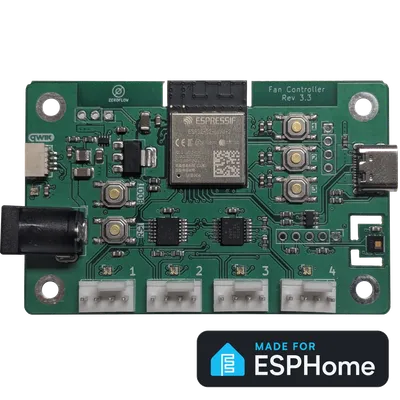
ESP32 WiFi Fan Controller
 Open Firmware
What Customers Say
"Product works amazingly and is even better than expected. Creator is quick to reply to issues and questions."
"Looks great, configurations and integration with Home Assistant were very easy to set up."
"Used the fan controller to control fans within my server rack which badly needed some cooling. Works perfectly."
Why This Fan Controller?
Intelligent Climate Control
Built-in HDC1080 temperature and humidity sensor with PID, linear, or curve-based automation. Your fans respond to real conditions, not guesswork.
Home Assistant Native
ESPHome-based firmware means instant Home Assistant discovery. Control fans from your dashboard, create automations, and monitor everything.
Hackable and Expandable
Qwiic/I2C expansion port, NeoPixel RGB LEDs, 3 user buttons, and fully open-source YAML configs. Make it yours.
Key Features
4x PWM Fan Outputs
Control up to four 4-pin PWM fans independently with smooth speed regulation.
Temp & Humidity Sensor
Onboard HDC1080 provides accurate temperature and humidity readings for automation.
RGB Status LEDs
Per-fan NeoPixel LEDs show status at a glance. Fully customizable colors and effects.
Qwiic / I2C Expansion
Standard Qwiic connector for adding external sensors, displays, or other peripherals.
USB-C Flashing
Modern USB-C port for initial firmware flashing and serial debugging.
OTA Updates
Update firmware wirelessly over WiFi. No cables needed after initial setup.
3 User Buttons
Assignable GPIO buttons. Give them a job in your ESPHome config: manual override, mode switching, or custom automations.
Low Power - 0.25W Idle
Energy-efficient design draws just 0.25W at idle. Always on without the guilt.
Fully Customizable
Open-source ESPHome YAML. Add modules, change behavior, or build your own control logic.
Ready to upgrade your setup?
Get the WiFi Fan Controller and take control of your cooling.
Buy Now - $35.99Frequently Asked Questions
What fans are compatible?
Any standard 4-pin PWM fan that runs on 12V. This includes popular choices like Noctua NF-A12x25, NF-F12, Arctic P12 PWM, and be quiet! Silent Wings. The board supports up to 4 fans with a combined draw of 2.5A.
Is a power supply included?
No. The Fancontroller requires an external 12V DC SELV power supply, which is not included and is not part of the product. It needs a 5.5x2.1mm barrel jack, centre positive, 12V DC ±5%, minimum 2.5A recommended depending on fan load. You must supply a power source that is certified for your region.
Can I use an old 12V adapter I already have?
We recommend a modern regulated switch-mode 12V supply. Old transformer-based adapters are often unregulated and can overvolt at light load, reaching 15 to 18V, which will damage the board. Quick check: measure the output with no load connected. It should read close to 12V, and anything above about 13V means don't use it.
Does it work with 5V fans?
No, the board is designed for 12V fans only. The barrel jack input is 12V DC, which is passed through directly to the fan headers. Using 5V fans requires a separate voltage converter.
How many fans can I control independently?
Up to 4 fans, each with independent PWM speed control and individual RPM monitoring. Every fan can run at a different speed based on temperature thresholds or manual settings.
Do I need Home Assistant?
Home Assistant gives you the best experience with auto-discovery and dashboard integration, but it's not strictly required. The controller runs standalone with ESPHome firmware - temperature-based automation works locally on the device without any server.
Can I use it to cool a server rack or network cabinet?
Yes, that's the most popular use case. Mount 120mm PWM fans (e.g. Noctua) in your rack and let the built-in temperature sensor automate fan speed. Many users cool rack-mounted servers, NAS enclosures, and network equipment this way, a straightforward smart home automation for any home lab.
How is firmware updated?
Over-the-air (OTA) via WiFi - no cables needed after initial setup. You can also update via USB-C. The board ships pre-flashed with ESPHome factory firmware.
Is the hardware open source?
Yes - the ESPHome firmware configs and the hardware schematics are published on GitHub. Only the Gerber/production files are not public. The board also features standard Qwiic/I2C and GPIO expansion ports for custom modifications.
What sensors are built in?
An HDC1080 temperature and humidity sensor is integrated on the board. You can add external sensors via the Qwiic (I2C) expansion port - for example, an additional temperature probe placed directly in the airflow.